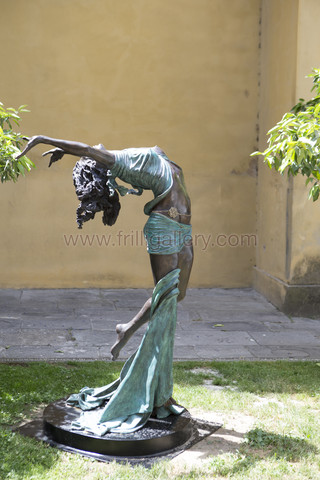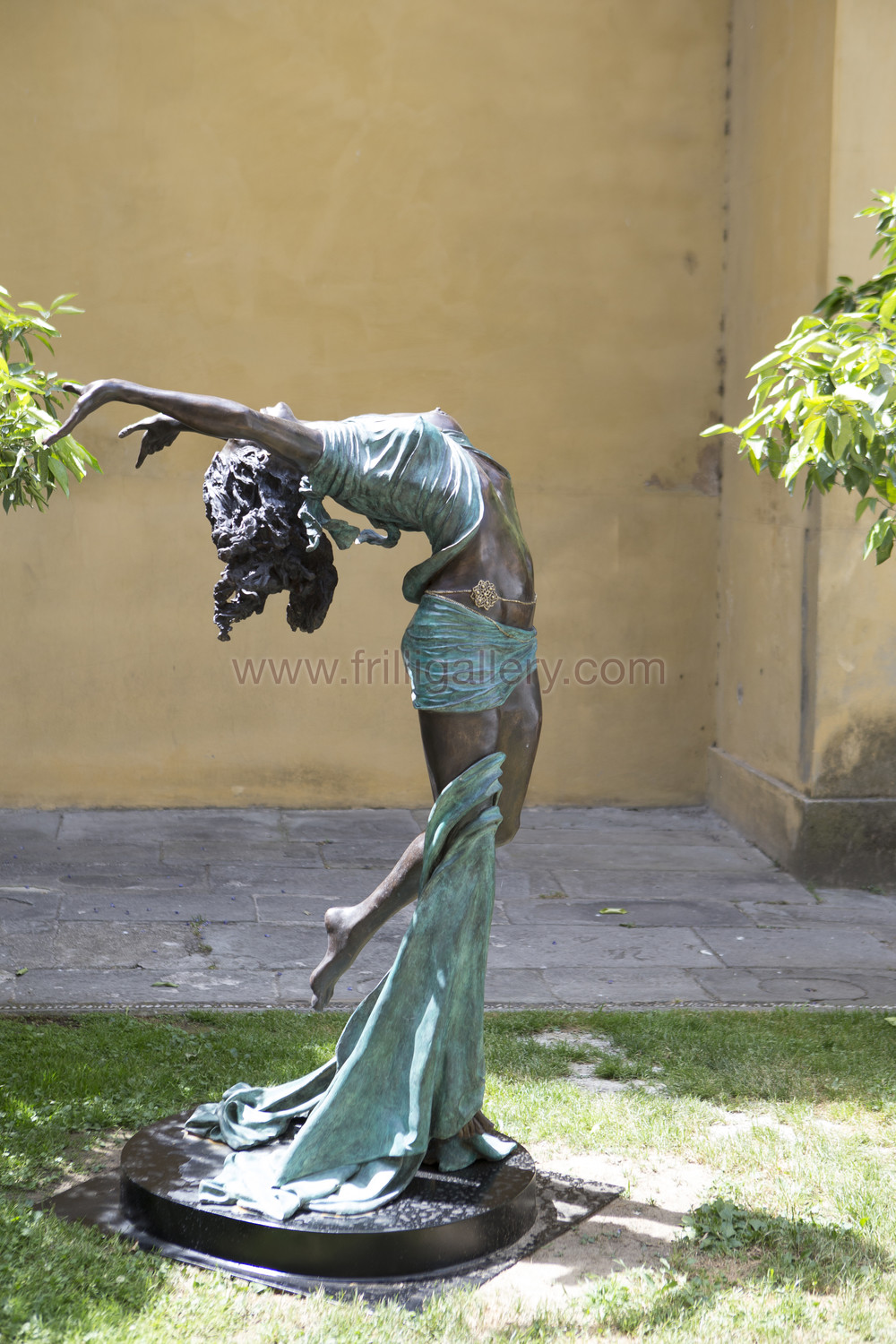
Margaretha MacLeod, better known by her stage name “Mata Hari” (Indonesian for “Eye of the Dawn”) was a Dutch exotic dancer and courtesan who was convicted of being a spy for Germany during World War I, and was executed by firing squad in France in 1917.
She had entertained the French and German troops, in turn, as the Battle lines moved to and from. Her “piece-de-resistance” being the dance of the Seven Veils. Her seemingly glamorous life was in fact full of drama and loss. Her marriage had broken up, she had lost her two children, and she had been accused of sleeping with generals on both sides and swapping war secrets in bed.
Although she was later found to have been a scapegoat for the incompetence of the generals, Mata Hari died defiantly in a hail of bullets, blowing a kiss to the firing squad.
Paddy's sculpture seeks to capture that moment, dancing to liberation in the cross hairs between life and death.
Disowned by her family, her body vanished. Paddy felt compelled to make this sculpture as a resting place for her spirit.
Although he used a live model for the pose, the Artist spent long days and hours, alone, struggling to keep it together. Later, he fought to save the wax from softening as he worked in one of the hottest summers experienced in Florence.
Somehow he felt that Mata Hari wanted him to keep going. This was an extraordinary experience as an artist; Paddy never regretted allowing her to finish her dance of the Seven Veils.
To request info for this item please use the following form